
Open almost any CRM and the first thing it wants is a deal. A name, an amount, a stage, a close date. The people involved get attached to that deal as contacts, which are roles in a transaction that the software is really tracking.
That shape is correct for a sales team. It is wrong for most people who need to remember who they know.
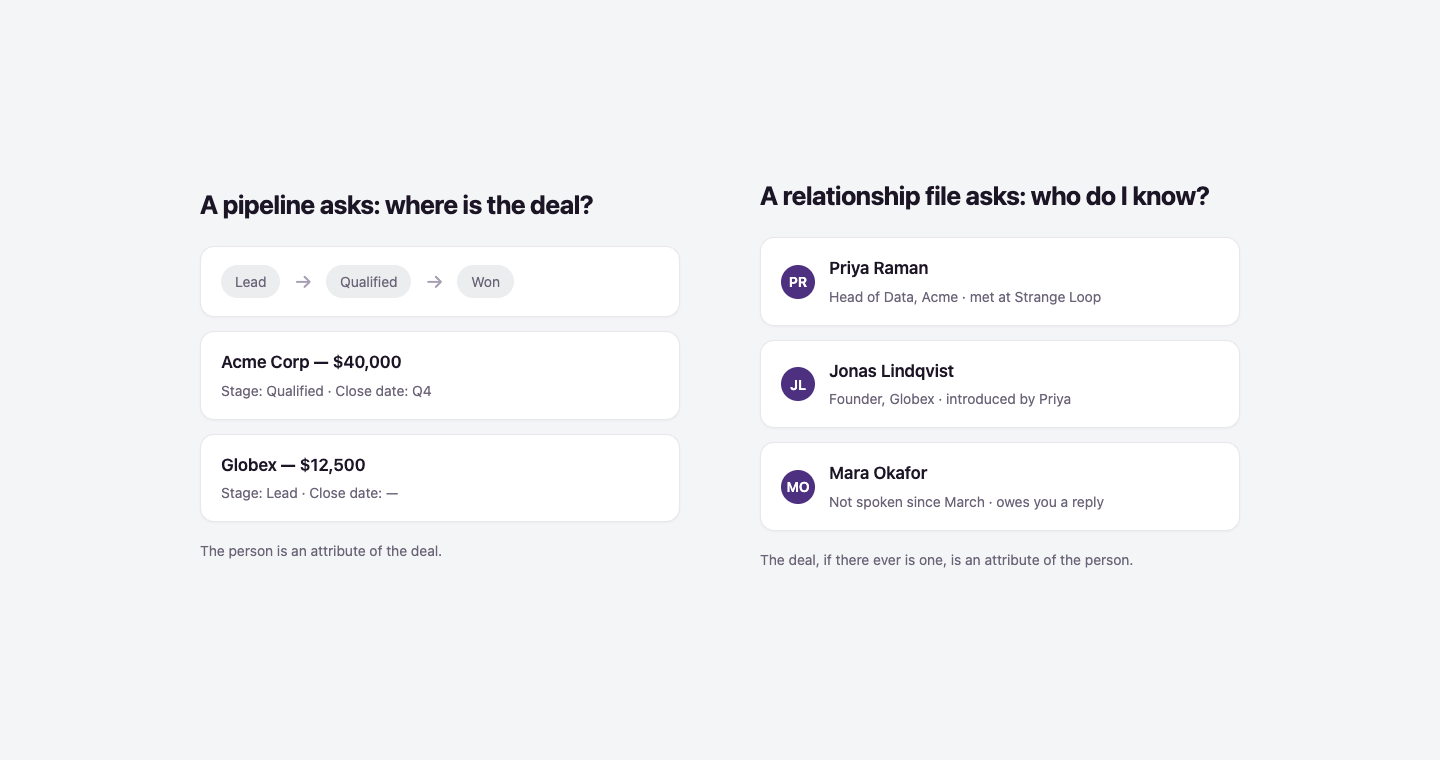
The question the software asks first
Software is opinionated about what matters, and the opinion shows up in what it makes easy. A pipeline makes it easy to answer where is this deal? and hard to answer who do I know at this company, and when did we last speak?, because the second question is not what the schema is for.
Turn the question around and the whole design changes. Put the person at the centre and their employer becomes context, the conversation becomes the record, and the follow-up becomes something the system can notice on its own.
What this looks like in practice
You write a short note after a conversation, in whatever words you would have used to tell a colleague about it. What was said, who was there, what you agreed to do next. That is the entire input.
What comes back is a record: the people mentioned, the companies they work at, and the things you said you would do. Not because you filled in a form, but because the note already contained all of it.
Where the two designs actually diverge
The distinction is not academic. It changes what the tool can do for you.
| Pipeline CRM | Relationship file | |
|---|---|---|
| Organised around | Deals and stages | People you know |
| A person is | An attribute of a deal | The record itself |
| Data entry | Fields, before the record exists | A note, in your own words |
| Succeeds when | The deal closes | You remember, and follow up |
| Belongs to | The team | The account that built it |
The last row is the one that tends to matter most. A sales pipeline is deliberately a shared asset. The company owns it, and it survives whoever built it leaving. A relationship record is the opposite: it is the accumulated memory of one person's working life, and it is worth very little to anyone else.
Why enrichment has to be a suggestion
If the record is organised around people, it will drift, because people change jobs and the record does not find out. So it has to be able to fill itself in.
The dangerous version of that is a system that quietly rewrites what you wrote because a third-party source disagreed. You would never know which parts of your own record you could still trust.
So updates arrive as suggestions to accept or ignore, and nothing overwrites your own words. The record stays yours in the plain sense: nobody else is editing it, and it is never sold or shared. That is also why the network sits behind an account rather than in a shared workspace. The details are in the privacy policy.
None of this makes a pipeline wrong. It makes it a different tool, built to answer a different question. The mistake is reaching for one when what you actually needed was the other.